A Symposium Celebrating
the Career of Steven Girvin:
From Many Body to Many Qubits


Rewatch the talks

About The Event


Professor Steven M. Girvin, the Sterling Professor of Physics, has truly shone throughout his amazing career, making groundbreaking contributions to theoretical physics, especially in many-body physics and quantum computation. His pioneering research has helped us better understand quantum systems, which has led to some groundbreaking advances in quantum information science. Steven Girvin is such a multifaceted person, bringing his extraordinary expertise and kindness to his teaching with students, his leadership as the previous Deputy Provost for Research, his research with colleagues, and his science communication with everyone.

We’re so excited to celebrate his career (so far!) at this symposium, from Many Body to Many Qubits!

Where:
OC Marsh Auditorium, 260 Whitney Ave, New Haven, CT 06511
When:
January 9 to 10, 2026


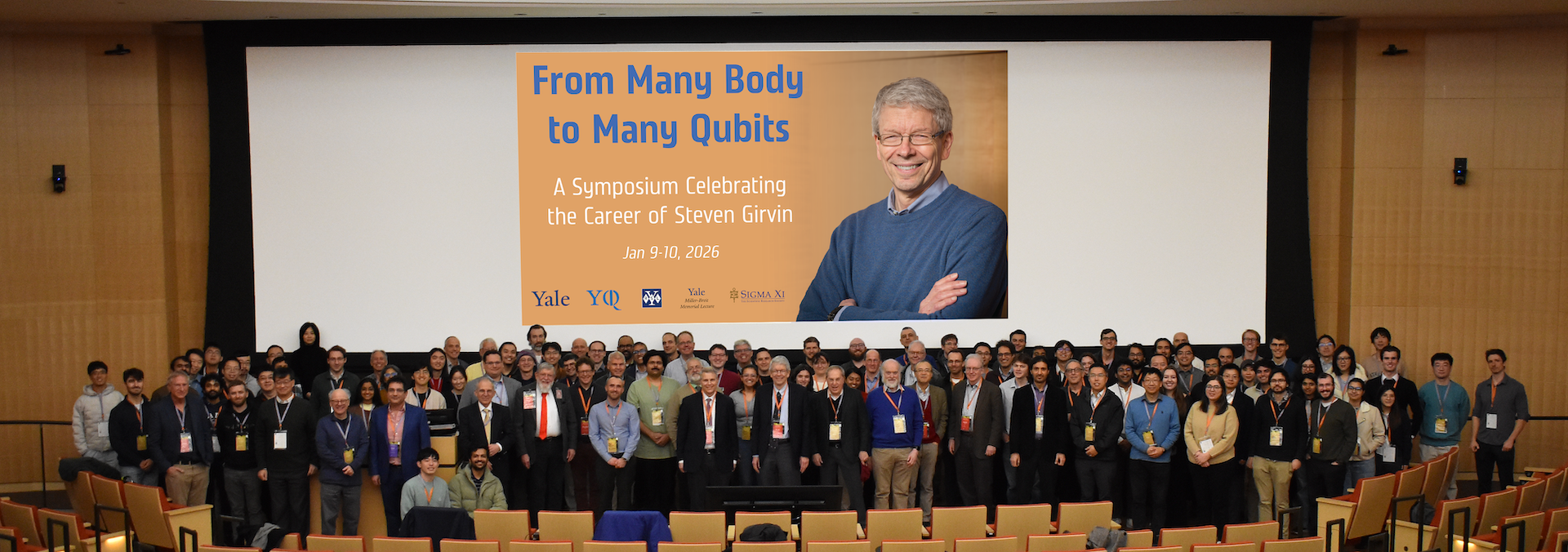
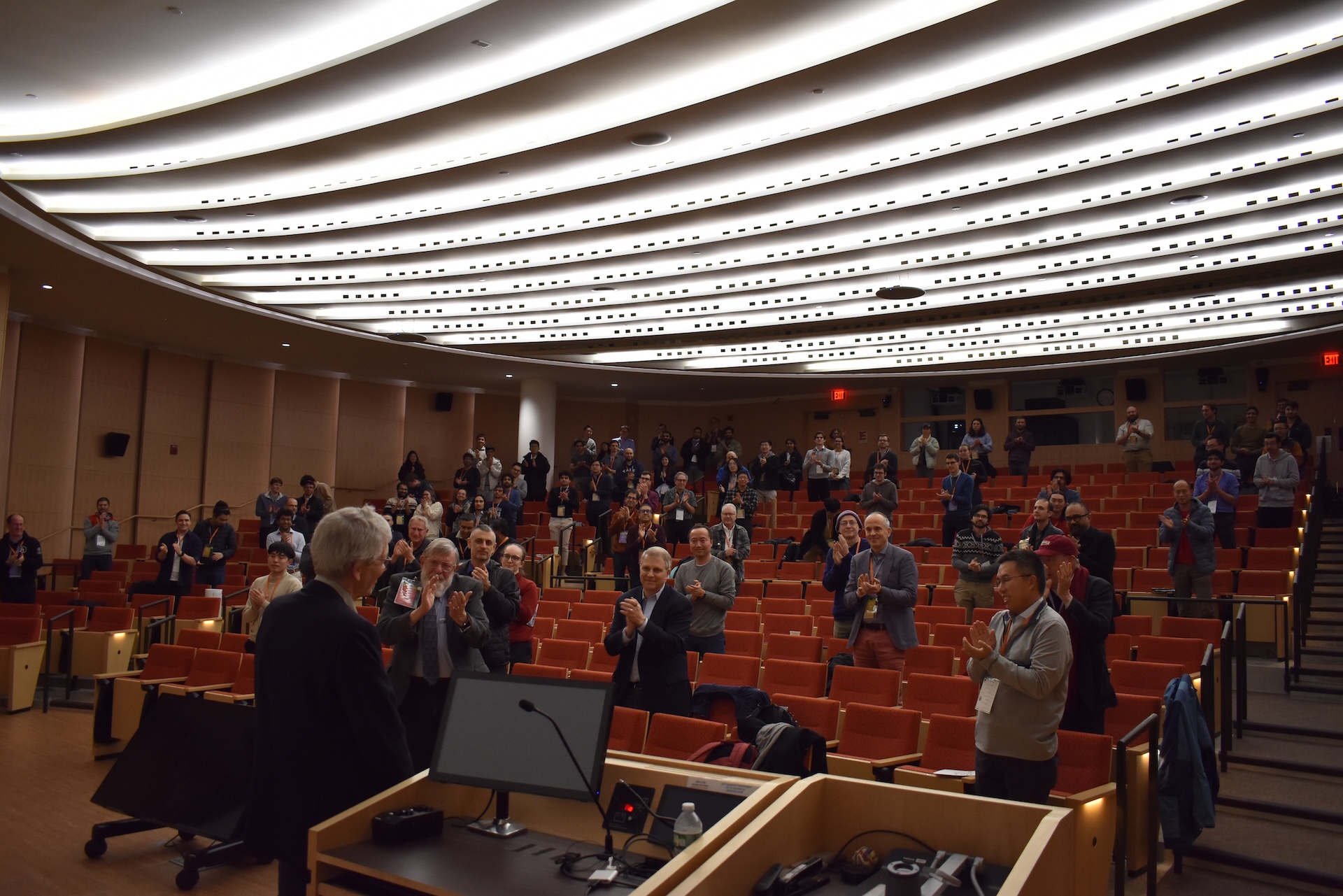
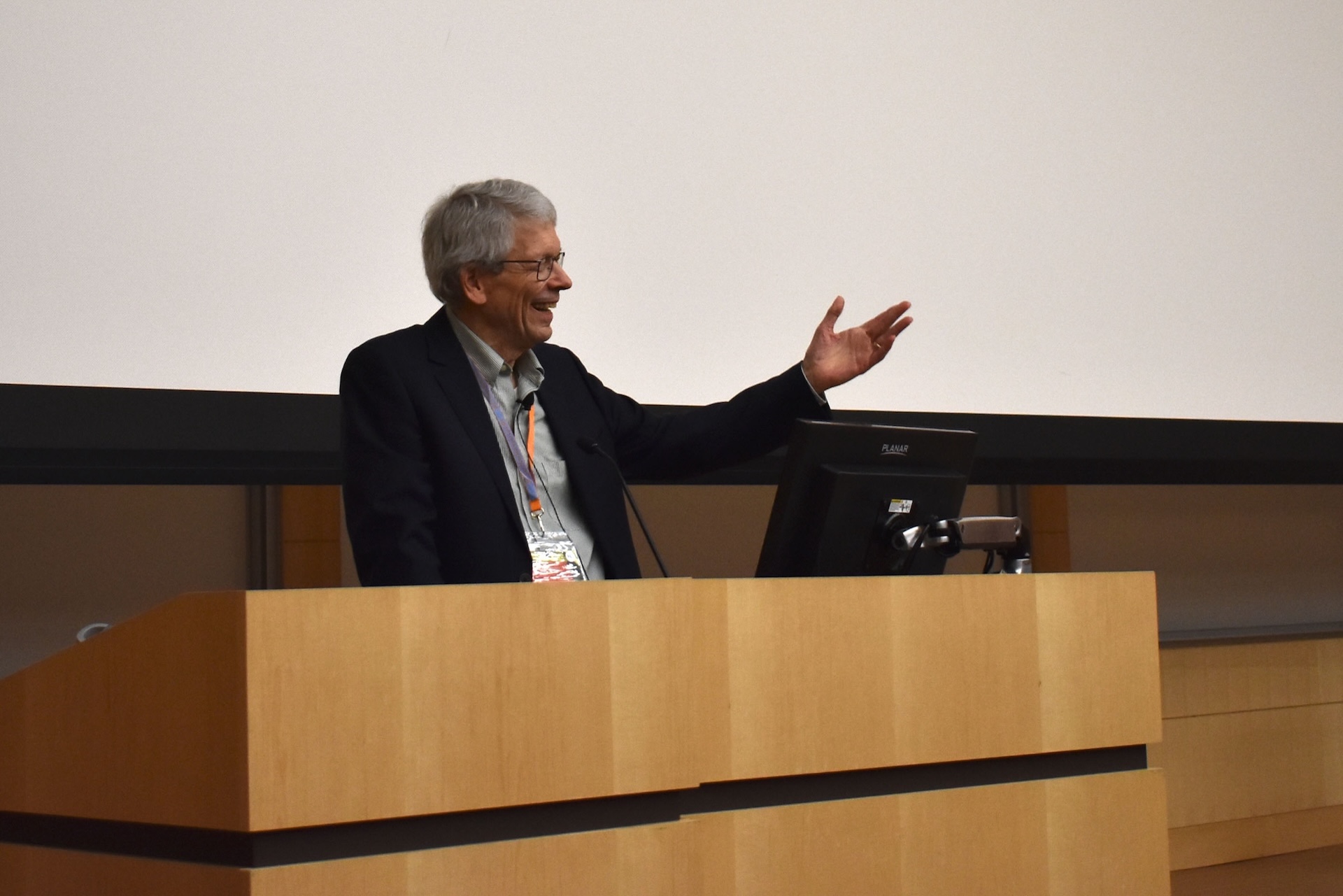
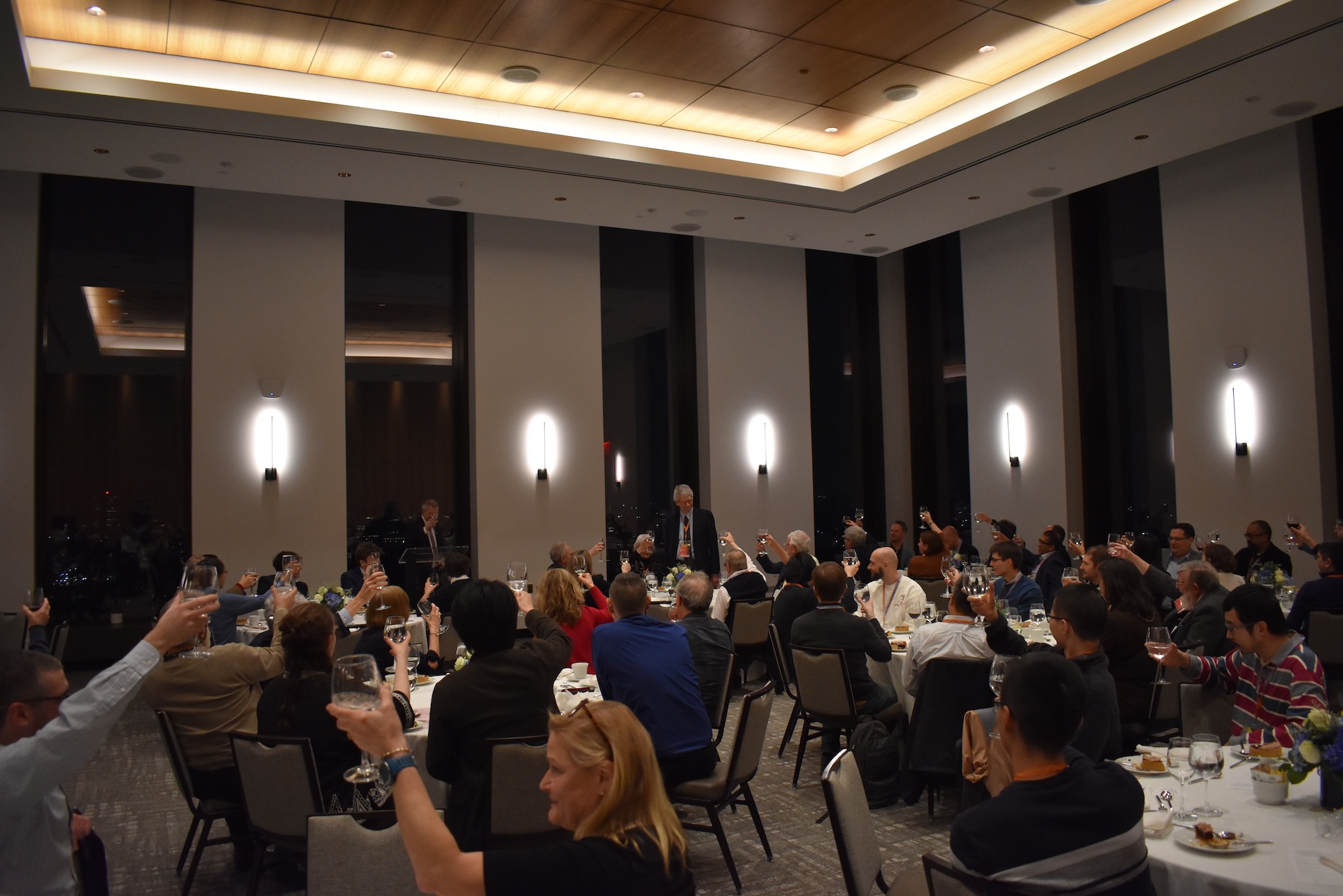
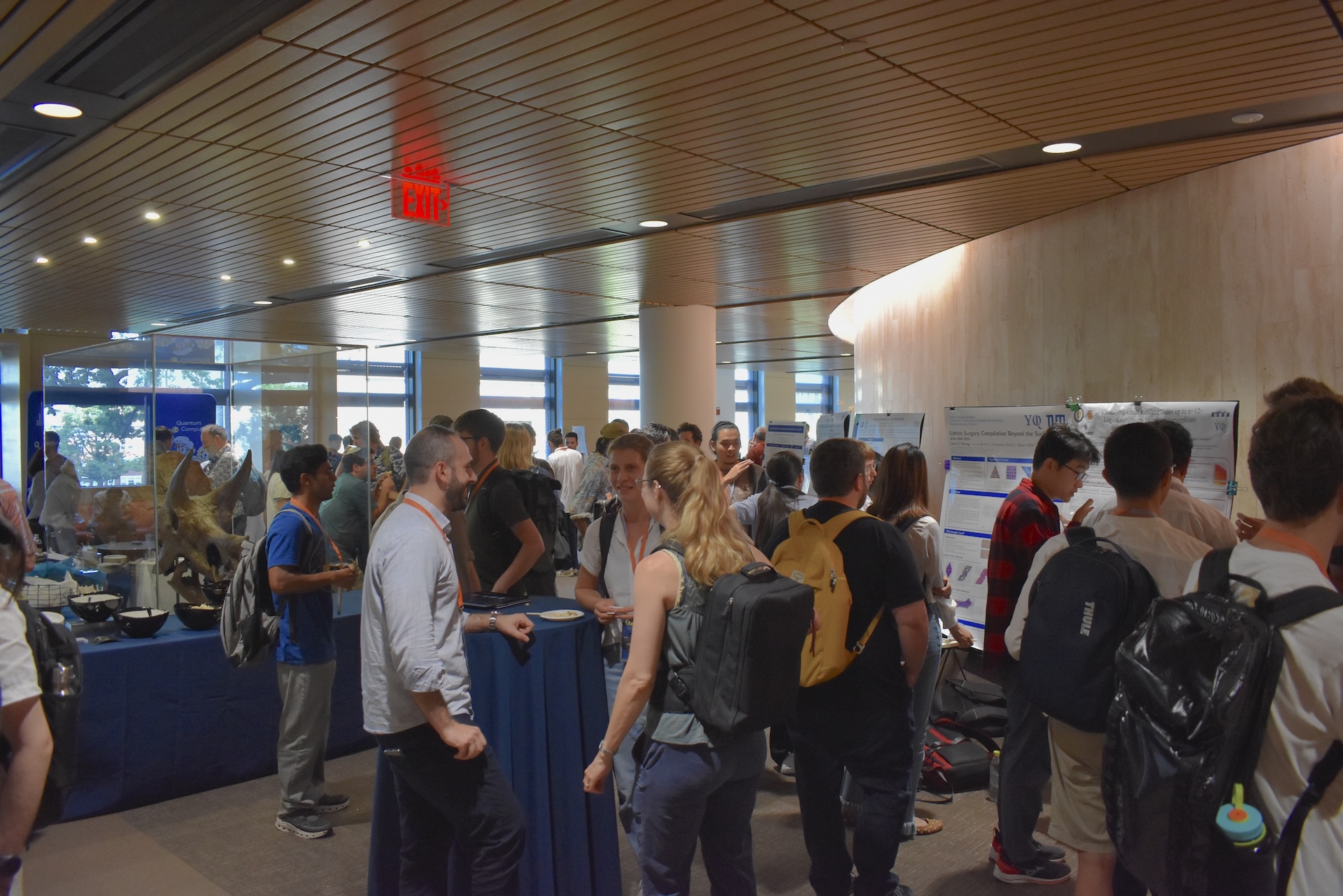
All the photos taken at the symposium are available to download here. Photos Day 1 and Day 2 by Florian Carle, photos of the Dinner by Shafton Haley and Florian Carle.


Speakers

Aashish Clerk
The University of Chicago
Aditi Mitra
NYU
Alexandre Blais
Université de Sherbrooke
Allan MacDonald
University of Texas
Charles Kane
UPenn
Florian Marquardt
Max Planck Institute for the Science of Light
Jun Ye
University of Boulder Colorado
Kun Yang
Florida State University
Matthew Fisher
UCSB
Michel Devoret
Yale, UCSB, Google Quantum AI
Per Delsing
Chalmers University of Technology
Rob Schoelkopf
Yale University
Shivaji Sondhi
University of Oxford
Shruti Puri
Yale University
Steven Kivelson
Stanford
William Daniel Phillips
University of Maryland


Day 1
Friday January 9, 2026
  • 8 - 9 AM

    Registration & Breakfast

  • 9 - 9:15 AM

    Michael Crair, Yale Vice Provost for Research
    Opening Remarks

  • SESSION 1 - Chair: Robert Schoelkopf

    Watch Session 1

    9:15 - 10 AM

    Aditi Mitra, NYU
    A universal model of Floquet operator Krylov Space

  • 10 - 10:45 AM

    Kun Yang, Florida State University
    From Magneto Roton to Chiral Graviton in Quantum Hall Liquids

  • 10:45 - 11:15 AM

    Coffee Break

  • SESSION 2 - Chair: Allan Macdonald

    Watch Session 2

    11:15 AM - 12 PM

    Alexandre Blais, Université de Sherbrooke
    Readout in cQED: Another Qubit Bites the DUST

  • 12 - 12:45 PM

    Per Delsing, Chalmers University of Technology
    Traveling wave parametric amplifiers based on 3-wave mixing

  • 12:45 - 2:00 PM

    Lunch Break
    Poster session 1: "From Many Body..."

  • SESSION 3 - Chair: Kun Yang

    Watch Session 3

    2 - 2:45 PM

    Matthew Fisher, UCSB
    Symmetry Breaking in Quantum and Classical Open System Dynamics
    In generic open quantum systems, universal dynamical processes tend to exhibit classicality - dissipation washes out quantum effects. Here I consider open quantum dynamics in the presence of a global U(1) symmetry. In mixed states, this symmetry can be either strong or weak, and distinct dynamical phases can be characterized by the spontaneous breaking of either symmetry. The strong-to-weak spontaneous symmetry breaking (SW-SSB) transition is characterized by various information theoretic quantities which are non-linear in the system’s mixed state density matrix. Within a Lindblad framework for U(1) dynamics, we show that a finite-time SW-SSB transition occurs in two and three dimension, whereas in one dimension the correlation length grows linearly with time and diverges only in the infinite-time steady state. Moreover, with carefully chosen Lindblad dynamics, the SW-SSB transition signals a finite time breakdown of quantum dynamics, giving rise to classical dynamics described by a stochastic Langevin equation (Model F of Halperin- Hohenberg). When the weak symmetry is spontaneously broken, the system enters a superfluid state with classical hydrodynamics.

  • 2:45 - 3:30 PM

    Shruti Puri, Yale University
    New directions for surface code QEC

  • 3:30 - 4:15 PM

    Charles Kane, UPenn
    Topology of the Fermi Sea

  • 4:15 - 4:45 PM

    Coffee Break

  • SESSION 4 - Chair: Michael Hatridge

    Watch Session 4

    4:45 - 5:30 PM

    Allan Macdonald, University of Texas
    Magneto-rotons: Then & Now

  • 5:30 - 6:15 PM

    Florian Marquardt, Max Planck Institute for the Science of Light
    Towards the Artificial Scientist

Day 2
Saturday January 10, 2026
  • 8 - 9 AM

    Breakfast

  • SESSION 5 - Chair: A. Douglas Stone

    Watch Session 5

    9 - 9:45 AM

    Steven Kivelson, Stanford
    Recent Progress on the Theory of the 2DES at larger rs
    Theoretical and experimental studies of two-dimensional electron systems (2DES) have played a pivotal role in the history of quantum condensed matter physics. It involves old, and much-studied issues, about which much is known. But then again, Steve Girvin is not so young, nor am I. In this talk, I will describe some new results obtained by some brilliant collaborators of mine concerning the quantum phases of the 2DES at large and intermediate values of rs, where rs is the Wigner-Seitz radius of the 2DES in units of the effective Bohr radius. I will also allude to some still unresolved oldy but goody puzzles – e.g. the existence of an “apparent” metal-insulator transition in 2D – and some new results – e.g. STM images of such systems – that may make the topic seem a bit less geriatric at present.

  • 9:45 - 10:30 AM

    Shivaji Sondhi, University of Oxford
    How might quantum platforms reshape many body physics?
    Quantum platforms are nearing a scale where they will allow the realization of a vast number of quantum circuits. Some of these will solve computational problems of interest to industry and commerce, others will answer questions about quantum systems that we normally ask. But this will still leave much room for searching for entirely new quantum phenomena. In this talk I will describe some thinking on one concrete possibility - that of looking for quantum Nash equilibria-and on a general method for using these platforms in "discovery mode" much like the use of particle accelerators for discovering new particle physics.

  • 10:30 - 11 AM

    Coffee Break

  • SESSION 6 - Chair: Jack Harris

    Watch Session 6

    11 - 11:45 AM

    Jun Ye, University of Boulder Colorado
    Nuclear clock – the latest updates inspired by Girvin

  • 11:45 AM - 12:30 PM

    William Daniel Phillips, University of Maryland
    Ultra-cold Atoms as a Kind of Condensed Matter System
    Gases of ultracold atoms share some of the properties of electrons in solids. Optical lattices influence such atoms in much the same way as crystal lattices do electrons. The atomic systems offer opportunities for measurement and control that are not available in solids, leading to surprising behavior even in elementary systems. Some phenomena that are difficult or impossible to study in solid systems are easy to realize in atomic systems. Simple, yet calculationally intractable, models for the behavior of condensed systems can be realized in atomic systems, which then act as quantum simulators of condensed matter models. Some cold atom systems have no analogous counterpart in condensed matter. This talk will describe some of these features of ultracold atomic gases, which provide not only an important complement to traditional methods for studying solids, but also represent an entirely new form of condensed matter.

  • 12:30 - 1:30 PM

    Lunch Break
    Poster session 2: "... to Many Qubits"

  • SESSION 7 - Chair: Liang Jiang

    Watch Session 7

    1:30 - 2:15 PM

    Michel Devoret, Yale/UCSB/Google Quantum AI
    The pleasure of doing quantum physics with Steve, and some recent related results

  • 2:15 - 3 PM

    Aashish Clerk, The University of Chicago
    Dissipative many-body entanglement: from sensing to symmetry-protected topological order

  • 3 - 3:30 PM

    Coffee Break

  • SESSION 8 - Chair: Liang Jiang

    Watch Session 8

    3:30 - 4:15 PM

    Robert Schoelkopf, Yale University
    Error Detection and Error Correction with Dual-Rail Qubits

  • 4:15 - 4:30 PM

    Steven Girvin, Yale University
    Closing Remarks

Poster Session


Poster Session

A poster session will be hosted during the symposium, accepting contributed poster presentations in two categories:

- From Many Body...
- ... to Many Qubits.

Interested students, postdocs, or researchers are invited to submit a title during their registration.


From Many Body...

1 - Anqi Mu - Columbia University - Dynamics and Phase Transition in the Dicke Model with Non-Markovian Dephasing
2 - Babak Seradjeh - Indiana University Bloomington - Floquet Topology from Twists in Irradiated Graphene
3 - Jinming Yang - Yale University - Realization of high temperature correlated state in triangular lattice 1T-TaSe2
4 - Nemin Wei - Yale University - Dirac-point spectroscopy of flat-band systems with the quantum twisting microscope
5 - Nir Navon - Yale - Quantum Many-body Physics with Programmable Fermionic Matter
6 - Ramin Abolfath - Howard University - FLASH ultra-high dose rate radiotherapy - A Many Body Framework
7 - Xian Du - Yale University - Electronic and lattice coupling effects in multilayer nickelates: a comparison with cuprates
8 - Yongxin Zeng - Columbia University - Composite fermion theory of fractional Chern insulators in rhombohedral graphene
9 - Zixiang Hong - Yale University - Universal Scaling Law For One-Photon Quantum Information


... to Many Qubits.

10 - Andreas Wallraff - ETH Zurich - Modular Superconducting Quantum Devices
11 - Eduardo Castro Muñoz - Yale - Enhancing Axion Dark Matter Searches with Single-photon Detection
12 - Eugene Dumitrescu - ORNL - Many Qubits and Many Qumodes To Compile Many Body Spectral Filters
13 - Harsh Babla - Yale - Fault-tolerant Fusion-based Quantum Computing with the Four-legged Cat Code
14 - Ivan Rojkov - ETH Zurich - Quantify and decompose entanglement using SWAP tests
15 - Jasper Bradford - UIUC 3D Fluxonium as a control qubit for bosonic quantum information
16 - Jinwoong Kim - Pfaff lab @ UIUC - Spins Meet Circuits: Parametrically Induced Strong Coupling
17 - John Garmon - Yale University - Parametric control of superconducting circuits with a linear inductive coupler
18 - Margaret Pavlovich - Yale - Optomechanical resource for fault-tolerant quantum computing
19 - Takahiro Tsunoda - Yale University - Fault-Tolerant Hamiltonian for Hardware-Efficient Encodings
20 - Thomas Smith - Yale - Erasure fluxonium
21 - Victor Albert - QuICS - Quantum error correction beyond SU(2): spin, bosonic, and permutation-invariant codes from convex geometry
22 - Wenxuan Xie - Yale Applied Physics - Band Structure and Dynamics of Atomic Lattices: A Unified Approach Across Dimensions
23 - Yuan Liu - North Carolina State University - Hybrid Continuous-Discrete-Variable Quantum Computing


Event Sponsors

Thank you to all the Yale Institutes and Departments for making this event possible.


Organizers


Prof. Aash Clerk
Prof. Alexandre Blais
Prof. Allan MacDonald
Prof. Rob Schoelkopf
Dr. Florian Carle
Kimberly Nuzzo

Registration

The registration fee for this symposium covers a portion of the cost of the event.
Online registration closes on January 6 at midnight, on-site registration will be possible
For questions, please email florian.carle@yale.edu

Internal

$100

  • Use this option for current Yale members
  • Payment with a COA only, no PCard
  • Students: Approval from PI required
Internal Registration CLOSED
External

$100

  • Use this option for external attendees
  • Payment by Credit Card only
  • All sales are final
External Registration CLOSED


Travel & Accomodation


Yale is located in New Haven, Connecticut, one of the best small cities in America, situated two-and-a-half hours south of Boston and one-and-a-half hours north of New York City. New Haven has many attractions including a thriving downtown district with parks, shops, museums, hotels, and restaurants. Its neighborhoods are home to historic buildings and diverse communities. Beyond the city limits lie beautiful beaches, peaceful lakes, charming New England towns, and pastoral suburbs. New Haven is easily accessible by car, train, bus, and airplane.


Airplane

If coming from abroad, the easiest way to travel to Yale University is by air. There are a number of nearby airports serviced by international airlines.

Bradley International Airport (BDL) in Windsor Locks, Connecticut

John F. Kennedy International Airport (JFK) in New York City

LaGuardia International Airport (LGA) in New York City

Newark Liberty International Airport (EWR) in Newark, New Jersey

Tweed New Haven Airport (HVN) in New Haven, Connecticut

Amtrak provides services from Newark airport to New Haven’s Union Station. For all other airports, private shuttle services are available through Connecticut Limousine (800.472.5466) and GO Airport Shuttle (866.284.3247). Please be sure to make reservations for shuttle services well in advance. Taking a taxi from any of these airports except for Tweed is not recommended.


Train

If traveling from within the United States, it is convenient to take a train to New Haven Union Station, minutes from Yale’s campus.

Metro-North Railways (800.638.7647) offers frequent train service between New Haven and New York City.

Amtrak (800.872.7245) provides train service to New Haven from Vermont, Providence, Boston, and Washington DC.

Once you reach the station, we suggest that you use a local taxi service to reach campus. There is a taxi stand at the station; a taxi ride costs approximately $10. Alternatively, local shuttles and bus services are also available for travel between Union Station and Yale.


Bus

If traveling from within the United States, it is also possible to take a bus to New Haven Union Station, which also serves as a bus terminal.

Greyhound (203.772.2470)

Peter Pan (800.343.9999)


Car

There are multiple driving routes that you can take to arrive on campus. We recommend entering “OC Marsh Lecture Hall, 260 Whitney Ave, New Haven, CT 06511” into your GPS.


Parking

Parking in New Haven is often challenging, but the city is very walkable. It might be easier to park downtown at the hotel and walk to the conference site, on Science Hill. Alternatively, on-street parking is available (see map here for location and rate) or public parkins are available nearby (LAZ Parkings at The Audubon New Haven Garage or Grove Street Garage)


Hotels

The following hotels are in New Haven, Connecticut and are located within a short distance of the Yale campus:


Additional options for accomodation, requiring substantial walking, or a short cab ride/drive:


Visa

Please apply for travel visas well in advance of the conference. For visa letters or other information, please email florian.carle@yale.edu with subject heading "Girvin Fest Visa Inquiry”.